Showing posts with label Limes. Show all posts

Wednesday, 22 February 2017

International Margarita Day


Happy International Margarita Day! Margaritas have to be my favourite cocktail. So much so that i have 9 Lime Trees planted in anticipation of unlimited fresh Limes always on hand. And at $30- a kilo i'm going to be rich! Haha! 

Here's my list of Limes planted in the garden.......
6x Tahitian
2x Australian Fingerlime
2x Key Lime
1x Kusaie

2x Kaffir


International Margarita Day is officially observed annually on February 22nd. This is perfect for us in Auckland, NZ as Limes are just maturing into ripeness. Margys, as they are known in our household (or "Troygaritas"), are the most common tequila-based cocktail. It is a cocktail that consists of Tequila, Triple sec and fresh Lime juice. A key ingredient is the freshly squeezed lime juice. The most common Lime to use is the Tahitian (Persian) Lime. However, margaritas in Mexico are generally made with Mexican limes (Key limes). These are small, thin-skinned limes and have more tart flavour compared to Tahitian Limes. Margaritas can be made with Lemons, they have a much softer taste. But i recommend to keep it authentic and use fresh Lime juice only. To juice my Limes i use a Lime Juicer like so:
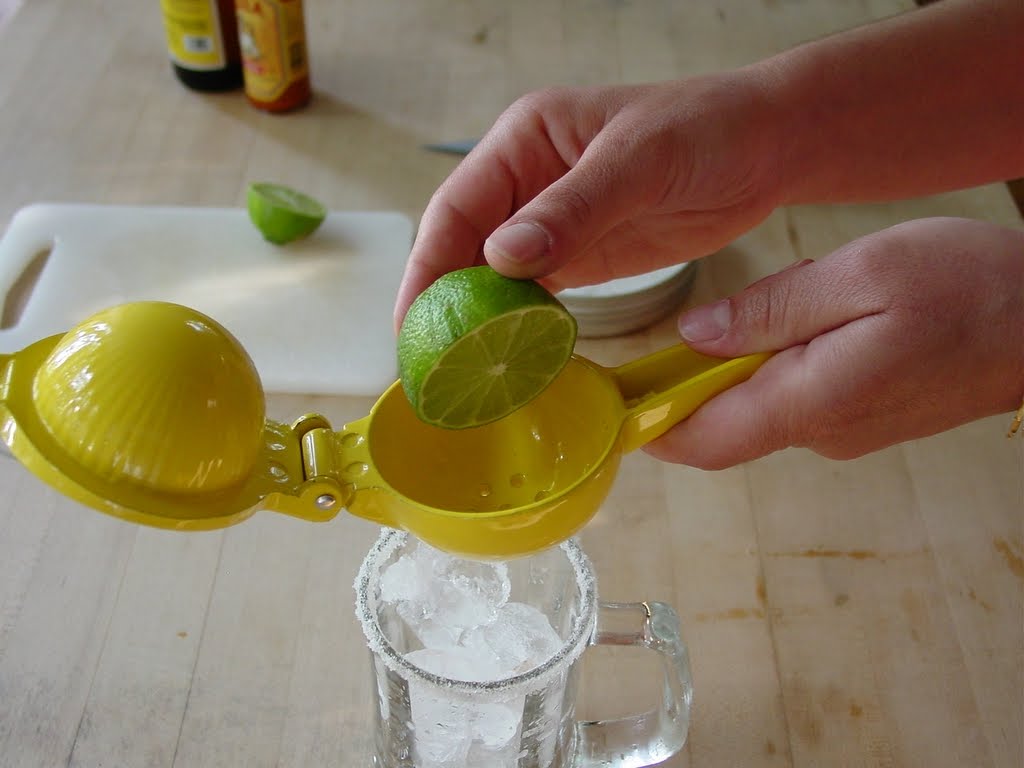

Manual juicing is often messy but this is as efficient as a machine juicer without making a mess. You simply slice the lime, face the flesh towards the holes, hold it over the measure, and give it a good squeeze. The mechanics of it make is simple to get enough pressure to juice a lime without having to go all Hulk on it. Then you just give it a quick rinse & dry off. It’s easy to use and easy to clean.

So here's a couple of my go-to recipes for a Margy. You can keep it Classic or funk it up with my Mescal Margarita or get really fruity and go for a Oaxacan Gold Pineapple Margy the choice is up to you! 

Classic Margarita.

70ml Tequila.
40ml Cointreau.
30ml Fresh Lime juice.
Salt.
Agave Syrup or Caster Sugar (to taste).

1. Rub the rim of glass with a Lime Wedge then dip the rim into a shallow plate of Salt.
2. Shake all ingredients with Ice.
3. Carefully pour into the glass with some Ice.
4. Garnish with a Lime wedge.

For the Classic i like to use a nice Anejo Tequila such as Patron or Herradura for a oaky aged smooth flavour or you can use Silver Tequila for a bright, clear flavour.


Mescal Margarita.

 70ml Mescal.
40ml Grand Marnier.
40ml Fresh Lime Juice.
10ml Agave Syrup.
Maldon Salt.
Lime Wedges.
*For a less smokey drink 35ml Tequila/ 35ml Mescal.
**You can Cointreau instead of Grand Marnier if you wish.
***For the rim you can make a blend of crushed Dried Chilies with the Salt.

1. Rub the rim of glass with a Lime Wedge then dip the rim into a shallow plate of Salt.
2. In a cocktail shaker add the Mescal, Grand Marnier, Lime Juice & Agave Syrup. Add a handful of Ice & Shake.
3. Carefully pour into the glass with some Ice.
4. Garnish with a Lime wedge.


Oaxacan Gold Margarita.


30ml Oaxacan Mezcal
.
15ml fresh Lime juice
.
75ml Grilled Pineapple-Vanilla Puree.

6 to 10  ice cubes.
Chilli Salt.
Roasted Pineapple-Vanilla Puree


1 Large ripe Pineapple, peeled & cut crosswise into 2cm thick pieces.

½ cup Sugar

½ teaspoon Vanilla Extract.

Roasted Pineapple-Vanilla Puree

1. Grill Pineapple until it is softened & caramelized. Cool.
2. In a blender, combine the grilled Pineapple with the Sugar, Vanilla & enough Water to bring the quantity of the total puree to 5 cups (about 2 cups water). Cover & pulse until the pineapple is roughly chopped, then blend on high until smooth & foamy.  Strain into a storage container, cool & refrigerate until you're ready to use, up to 3 days.

3. Rub the rim of a glass with a Lime Wedge then dip the rim into a shallow plate of Chilli Salt.
4. In a cocktail shaker, combine the Mezcal, Lime juice, Grilled Pineapple-Vanilla Puree & Ice. Shake until frothy & cold. 
5. Pour into the prepared glass with Ice.


For more Margarita recipes check out my book called 'Viva La Mexico' its available for free download as an e-book at www.blurb.com/my/ebooks/639073-viva-la-mexico


Saturday, 2 July 2016

Key Lime Pie Recipe


My Mum Brenda, who lives down in Katikati in the Bay of Plenty, popped up to visit 
the other day and luckily for me she brought me a big bag of Limes from her Lime trees. I gave her a few trees a few Christmas's ago and helped plant them in and she is always very generous in sharing her excess produce. I still have some on my trees too but i manage to get through them fairly easily. With such a haul i thought that i should make a Key Lime Pie as i have wanted to try the recipe out for a while now. Though these limes are Tahitian Limes, i don't think there should be much difference in flavour. This is a staple recipe from the Florida area (i.e.: the Florida Keys) where Key Limes used to reign supreme. Nowadays due to Hurricanes that have wiped out a lot of the Key Lime Plantations in Florida, a lot of the US's Key Limes come primarily from Mexico or Guatemala. Floridian Lime orchards were subsequently replaced with the less thorny Persian (Tahitian) Lime.Here's the Recipe:


Key Lime Pie

Ingredients:
4 Egg Yolks
1 cup Fresh Lime Juice
2 x (414ml) cans sweetened condensed milk
1 1/2 cups Graham Cracker Crumbs or Ginger Nut Crumbs
6 TBS (60gm) Butter, melted.

Directions:
1. Combine crumbs and melted butter in a bowl. Press mixture into the bottom of a 12-inch springform pan. Bake at 180º C. for 10-15mins. Set aside to cool.
2. In a large mixing bowl, combine the Sweetened Condensed Milk and the Eggs and mix until the eggs are fully incorporated. Add the key lime juice and mix again until well mixed. 
3. Pour mixture into the cooled Pie Crust. Bake at 180º C for 15-20mins until the center is set but still quivers when the pan is nudged.
3. Let fully cool before slicing. 
4. Top off with whipped cream on the top if desired as below or perhaps Meringue.

"Tequila" Key Lime Pie:
Add in 1-2 TBS of Tequila into the Filling mixture before filling the Pie Crust.


Wednesday, 22 June 2016

Taste Test: Kusaie Lime


I've had this Kusaie Lime now for about 3 years. I brought it by mistake as i thought it was another name for Key Lime which i have heard good reviews of. It is however, a different Lime. When i first tried one i used it as a wedge for a Corona and instantly disliked it due to a weird Camphorous flavour. It was then banished to the back of the garden. Today however i noticed the tree is laden with about 20 fruits so i thought i would give him another chance. So i juiced three with my Lime squeezer and made some Lime-onade with the Soda Stream. When just using the juice only, the lime is actually really good similar to maybe a spicy Meyer Lemon in flavour. Sweet, floral and spicy. I think it is the peel that is the source of the medicinal, resinous flavour so i recommend avoiding for lime wedges or zesting. I'll be definitely using the rest of the fruit on the tree now and taste them further. I went on to make a Mescal Margarita that night and it was exceptional! I have to say though, Tahitian Lime is still the favourite for flavour in my opinion. The elusive Key Lime though, is still yet to be sampled. Kusaie is also quite an ornamental fellow if just grown for that purpose alone. Lots of pinkish-white blossoms and then yellow fruits to follow.


Kusaie should be regarded as a yellow-fruited form of the Rangpur and therefore called the Kusaie Rangpur.  The tree is indistinguishable from other Rangpurs and the fruit differs significantly only in colour. Almost certainly this variety originated in India. It was introduced into Hawaii from Kusaie Island, of the Caroline group in Micronesia in 1885. Kusaie is said to have local importance as an acid fruit in the Hawaiian Islands.  Elsewhere in the United States it is a collection item or oddity.

Avocado - Avo-geddon

As many Aucklanders may be aware we are currently in the midst of Avogeddon. Where for some it seems like the end of the world has arrived where they can't enjoy their usual Avocado & Vegemite on Vogel's toast without shelling out up to $9 each for an Avo! Avocados have become the Uber trendy essential ingredient of the minute with the Active-wearing, Almond Mylk Latte, Green Smoothie sipping types. And it's this popularity that is driving prices up and creating scarcity. This is compounded also by a lot of our NZ Avos going directly overseas as exports, further creating scarcity back here in NZ. We are only just now in my cafe finding relief with new season Avos trickling in but usually Haas won't officially mature until July.
One of the most longed-for fruit trees by home gardeners is an Avocado. Being a native of Central America, Avocado culture is very ancient and was a staple diet for many cultures. The fruit is great in so many dishes including one of my favourites: Guacamole (recipe below). Unsurprisingly, given their Central American ancestry, avocado trees only thrive in warm locations. A light frost will burn any tender growth, and anything cooler than -3°C will kill a young tree. The best growing areas in NZ are Northland, Auckland, Gisborne, Hawke's Bay & Bay of Plenty where the majority of NZ Avo farms are in Katikati. 

At home i have one grafted Haas Avocado tree planted inground and another two that grew out of the compost randomly that are in pots. My thoughts are i'll only have the one inground as they grow in to quite large trees eventually and can use the potted plants as pollinators perhaps.


GROWING GUIDE
Below ground, the roots are very sensitive. The deep-growing tap root (a long slender root, similar to a big carrot) loathes heavy, clay and wet soil. The roots are susceptible to the fungal disease phytophthora, which thrives in difficult dirt. Avocado trees need excellent drainage, which means free-draining soil or, if unavailable, planting into a raised bed.
Site selection is very important to provide a warm, sheltered position for your valuable avocado tree. As well as the soil requirements, the site should be protected from wind and be warm and sunny. 
The best time to plant avocado trees is in late spring when the soil temperature is warming, which also reduces the likelihood of wet feet. This is also the main time of year that most avocado trees arrive at garden centres, probably to ensure the greatest chance of success when planting. Take care when lifting your new avocado tree from the garden centre or nursery. You should pick up the bag, not using the trunk as a handle.
VARIETIES
Around the world, the most popular variety for commercial growers and in home gardens is
the pebbly-skinned 'Hass'. With its long harvest season, excellent flavour and good flesh-to-seed ratio, 'Hass' has dominated production since it was spotted as a seedling in a Californian orchard in the 1930s. Hass is still considered the best option for the home gardener, usually supplying fruit from July until the following February or March. If you have room for two trees though,
'Reed' (ripening from February to May) has fantastic quality fruit with delicious, creamy flesh.
This is a green skin fruit with a hard shell-type skin, so it can a bit tricky to know when it's ripe. With a thicker skin than 'Hass', the flesh will only give very slightly when gently pressed. 'Fuerte' is another good variety, which has large fruit with a nutty flavoured flesh, ripening from August to October. 
PROPAGATION
Avocado seedlings are one of the easiest seeds to germinate. I think everyone has tried the avocado stone, toothpicks, cup and windowsill technique. Unfortunately, though, these seedlings can take up to 10 years to fruit, and the resulting avocados are likely to be of poor quality & not the same as the original fruit that the seed came from. The seedlings can be raised, however, until the stem is around pencil thickness, then grafted with a selected variety, such as 'Hass' or 'Reed' if you have such skills. Or else grafted Avocados are available at the Garden Centre but these are one of the most expensive fruit trees you'll see.
BLOSSOM & HARVESTING
Avocado trees have an unusual flowering system, in that the flower has both female and male organs. The female opens first for a couple of hours, closes, then the male opens for two or three hours, then the flower closes.
Avocado varieties are split into A and B types. In the A type ('Hass' and 'Reed'), the female opens on the morning of the first day and the male opens on the afternoon of the second day. In the B type (like 'Fuerte'), the female opens on the afternoon of the first day, and the male on the morning of the second day. Temperatures during this process are critical – dropping below 21°C  will make the flower opening more erratic.
Avocado trees have a prolific flowering period, with large clusters of blooms. Bees and other insects move the pollen between flowers. Flowers that are successfully pollinated form fruit. In commercial avocado orchards, pollinator varieties are planted, but in a home garden situation, usually one tree is sufficiently self-fertile.
Once fruit has set it takes up to a year for the fruitlets to mature – one of the longest times from flowering to fruiting in the orchard. The fruit will be mature, but interestingly, won't actually ripen until harvested.  They should be clipped from the tree using secateurs, to avoid damaging the skin and keep the stem "button" in place. 
TREE CARE
Once established, avocado trees require very little care: simply pruning to the desired size and shape. Bear in mind that avocado trees produce fruit on new growth, so clipping around the periphery of the tree will lower yield (although that trimming may be necessary to control size). Most Avo orchards i see will prune out the centre of the tree to let in as much light as possible into the canopy and to keep it at a manageable size.


Guacamole Recipe


3 Avocados.
1/2 Red Onion.
Chilies - Jalapenos or Hot Sauce.
1 Tomato.
1 or 2 Limes (or Lemon).
1 bunch Coriander.
Salt & Pepper.

1. Peel & roughly mash Avocados
2. Finely dice the Red Onion then rinse under water in a sieve.
3. Core & Dice the Tomatoes.
4. Juice the Lime
5. Finely chop the coriander.
6. Finely chop the chilies add to taste.
6. Add all the ingredients into a bowl & stir.
7. Season well with Salt & Pepper.
8. Garnish with extra Coriander & serve with Corn Chips.

For an added authentic flavour add in 4 large roasted Tomatillos. If you haven't tried Tomatillos i highly recommend looking into them for your mexican recipes. For more Mexican inspiration, check out my book "Viva la Mexico" it's a free download at www.blurb.com/ebooks/379548-viva-la-mexico


Monday, 6 June 2016

Pomelos: The President of the Citrus Club.


If you've ever been to the supermarket and seen a giant, soccerball sized citrus then you've probably come across a Pomelo. 
Pomelos, or Citrus maxima, are native to Southeast Asia.  They are the largest of the citrus fruits, and most closely related to grapefruits. They may look intimidatingly large but these oversized fruit are mostly all pith (much thicker pith than other citrus varieties) and once peeled are a much more managable size. 
They have a textured rind ranging in colour from pale green to yellow when ripe with pulpy flesh that's creamy white, bright pink, or somewhere in between. They also have a very thick albedo (rind pith) which needs to be peeled away before eating. Like many of its relatives, pomelos can vary between being filled with seeds, to having very few or no seeds. It is a large citrus fruit, 15–25cm in diameter, usually weighing 1–2kg.
 Pomelos are like a mild version of grapefruit (which is itself believed to be a hybrid of Citrus maxima and the orange) though a pomelo is much larger than the grapefruit. They're sweeter and don't carry that occasional harsh bitter tang. It has very little of the common grapefruit's bitterness, but the enveloping membranous material around the segments is bitter, considered inedible, and thus is usually discarded. 
Next to the interesting flavour, what I like about eating Pomelos is that it feels like an adventure. It takes work to get to the sweet, pulpy flesh. Though once you do, the reward is deeply satisfying and worth every second of your efforts. After removing the thick rind and peeling the membrane from around the segments, pomelos can be eaten out of the hand, tossed into salads or salsa, made into jam, or juiced for a cocktail. You can candy the peel it, or use it to make marmalade. My favourite recipe for Pomelos was inspired by my travels to Cambodia a few years back. Here's the recipe:


Pomelo Salad

1 Polemo.
1 Capsicum.
1 Carrot.
1/2 Cucumber.
50gm Peanuts.
1 small handful of Coriander or Thai Basil
1 Radish.
1/2 Spring Onion or Shallot.
1 small Red Chilli.
50gm Fresh Coconut.
1 Avocado
Dressing:
1 Lime, juiced.
2 TBS Fish Sauce.
1 TBS Soy Sauce.
1 tsp Palm Sugar.


1. Peel the Pomelo & remove each segment from its outer membrane. Set aside.
2. In a small bowl, combine the Fish sauce with the Lime juice & Sugar. Stir to dissolve the Sugar completely. Set aside.
3. Crush the Peanuts into little pieces.
4. Peel & discard the skin off the Carrots & Cucumber. Then make long strips with the peeler.
5. Using a Mandoline thinly slice the Capsicum, Fresh Coconut & Radishes. Thinly slice the Spring Onion. Finely dice the Chilli.
6. In a large bowl, toss ingredients with the dressing. 
7. Arrange a mound on a plate. Garnish with the Coriander & Peanuts.


This recipe is from my book "Cook & Be Cool" its available as a free ebook here: www.blurb.com/ebooks/476025-cook-be-cool


Saturday, 4 June 2016

Kaffir Lime

Photo: Will Luo
Kaffir Lime leaves bring an elusive, slightly floral flavour to Thai food. But how do you use the bounty of this thorny brut?

Native to tropical Asia, Kaffir lime is a fragrant member of the citrus family. The tree is small and shrubby with distinctive leaves that have a petiole almost as large and wide as the leaf blade. Both the leaves & pungent, knobbly fruit are key ingredients in the cuisines of South East Asia, particularly Thailand, where they form the sensory backbone of so many curries, soups and spice pastes.
It is best summed up as the elusive, floral and resinous quality lurking beneath the surface of many famous Thai dishes. The two-lobed leaves are added to curries, and the rind of the fruit is used widely in spice pastes. They have very little juice which is bitter & sour, & never used in cooking, but it is said to make a good shampoo which i have yet to try. Both leaves and rind are assertively aromatic with notes of Citron, Damask Rose and Violets.


Photo: Robyn Jay


Fresh Kaffir leaves can only sometimes be found at premium supermarkets or fruit stores. So it is probably best to grow your own little tree for the rare occasion you need some. Fresh, tender young leaves are the preferred choice for salads. To slice the leaves for salads, slice on either side of the stem, which is tough and so best removed. Then tightly roll up and thinly shred. Whole leaves are leathery and largely inedible so remove before serving. The fruit eventually ripen to a spongey, dull yellow but are best used when hard, shiny and green. The riper they are the lower the essential oil content and therefore flavour.
Most garden centres stock the trees these days and given a warm, frost-free & sunny spot they will keep you well supplied with leaves and fruit for many years. They are very thorny trees, so take care where you plant them.
Last time i was in Koh Phangan, Thailand i did a cooking course & learnt how to make Thai Red Curry from scratch. Here's the recipe:

Thai Red Curry

Paste ingredients:
1 thumb Galangal
1 tsp Black Peppercorns
1 tsp Salt
1/2 tsp Shrimp Paste.
3 cloves Garlic
2 Shallots
2 Coriander Roots
2 Lemongrass stalks
1/2 Kaffir Lime, zested.
2 dried Red Chillies, rehydrated.
400ml Coconut Cream
4 Kaffir Lime leaves, shredded.
2 TBS Fish Sauce
1 TBS Palm Sugar
3 sprigs Thai Basil

1. Finely chop all the ingredients. Then pound well in a mortar.
2. Fry the Paste in oil.
3. Add the Coconut Cream & Kaffir Lime leaves. Simmer for 3 mins. Season with Fish Sauce & Palm Sugar. 
4. Add in the Prawns, when they are cooked add in the Thai Basil.
5. Move to a serving bowl & garnish with Kaffir Lime leaves & Thai Basil leaves. Serve with Rice.


**Note: The word 'kaffir' is a highly offensive racial slur of colonial South African origins. It was originally directed at black Africans. The popularity of the fruit among these slaves is thought to have led to its common name. It's unfortunate that this name has stuck but if you must use the 'K' word, try to mispronounce it, e.g. 'kaff-eer', never 'kaff-uh'.

Saturday, 26 March 2016

Lime Harvest.


One of my most treasured citrus fruits is the Tahitian Lime. So much so i have SIX Limes planted at home! A Lime tree is essential for any Foody's home garden in my opinion, as it has so many uses in the kitchen. Limes grow very well in my Auckland garden and are quite vigorous growers & the zesty fragrance of a freshly picked Lime is second to none. Non-grafted Limes can grow into large trees over 2-3m if left unpruned. The main issues growing them are Whitefly, Aphids, Scale and the dreaded Lemon-tree Borer. I don't like to spray my trees i like to think nature will sort it out. But if things get a bit Cray in there, such as lots of sooty mould due to insect secretions, i'll spray some Horticultural Oil mixed with an Organic Insecticide to help control the pests. 

Another passion of mine is Mexican food of which Limes are an essential part of. 
From Guacamole, Ceviches to Fresh Salsas or for that finishing squeeze on a Taco, Limes have a refreshing zest that balance out the Chilli and add an aromatic, sour tang.

My favourite cocktail, the Margarita, also uses Limes extensively. Tequila, Lime & Salt is such a winning flavour combination. A really good idea for juicing the Limes is to get a Lime Squeezer to extract every bit of precious Lime juice.

Here is my recipe for Margaritas:

70ml Tequila.
40ml Triple Sec.
30ml Fresh Lime juice.
1-2 tsp Agave Syrup or Caster Sugar.
Coarse Salt.


1. Rub the rim of glass with a wedge of lime, then Salt the rim.
2. Shake all ingredients well with Ice.
3. Carefully pour into the glass.
4. Garnish with a lime wedge.


For more recipes using Limes check out my book called 'Viva La Mexico' its available for free download as an e-book at www.blurb.com/my/ebooks/639073-viva-la-mexico