Showing posts with label Orange. Show all posts

Monday, 19 December 2016

New Citrus: Kiyomi Tangor & Okitsu Wase Mandarin


This week i have acquired two new Citrus buddies for the garden with both being able to be ready to eat straight off the tree. 
The first is the Kiyomi Tangor. I chose this guy as i've been FOMOing about the Sumo/Dekopon tree for a while now (check out my post here) and i discovered that Kiyomi is one of the parent varieties of the Dekopon so would be worth a try.
Kiyomi is a Tangor hybrid. It has a parentage of Miyagawa-wase (Satsuma mandarin) crossed with a Trovita orange at the Okitsu Branch, Fruit Research Station in Japan in 1949. It was named Kiyomi after the temple Seiken-ji (清見寺) and the lagoon Kiyomi-gata (清見潟) near its experiment station in Shizuoka city
Fruit are medium-large (150-200 g), flat, seedless, juicy, and orange scented.
The tree bears good crops of large, bright orange fruit with pebbly-textured skin that is fairly easy to peel. Rich and spicy in flavor, Kiyomi are sweet. Sugar content is normally 11–12°Bx and reaches even 13°Bx if conditions are met. Citric acid content is around 1%. It has no seeds. They will ripen about late September in NZ. The flavour is similar to that of a mikan Mandarin, while the aroma is similar to that of an Orange.


The second tree i chose this time is the Okitsu Wase Mandarin. I chose this tree as i had read promising things about them via the Fruit Mentor. In his taste test of over 60 varieties, Okitsu Wase was the overall winner:

"Okitsu Wase Satsuma was the overall winner. Tasters reported Okitsu Wase to be sweet with excellent flavor and very juicy. One taster also noted its fragrant skin. On a scale from 1 to 9, Okitsu Wase scored 7.3, a bit higher than “very good” (7)."


Another desirable quality is that Okitsu Wase is an early season Satsuma, in fact is the earliest ripening cultivar so is a good choice to help extend the season.

The fruit is Seedless, Easy Peel, good rich flavour with low acid and high sugar.  The skin has smooth pale yellow peel, and plump, juicy flesh. 


Okitsu is a variety from the Unshiu tangerine group Wase, second most popular and cultivated variety in Japan. It was discovered in 1940 as a Miyagawa' seedling in the Okitsu research station, Honshu. It was bred by crossing 'Miyagawa' with Poncirus. It is most commonly growing in the colder subtropical areas with harsh winters.


'Okitsu' is a big shrub or a small tree, it can grow up to 2,7m and has very wide, spherical crown made of curly branches with small spikes. The foliage is usually very scarce, but the large, pointed leaves resemble those of Unshiu tangerine 'Clausellina'. 'Okitsu' starts producing at very early age and is fairly resistant to cold but also dislikes hot and dry climates and can easily get sun-damaged during hot weather. It is also necessary to thin the fruit shortly after formation, because this variety usually produces much more than it can bring to full ripeness. Pollination is not required to produce high yields. Okitsu fruit is distinctively spherical or slightly flattened, average (5,5-8cm) weighs 120-190g and has a small navel with big neck. Its dark orange rind is soft, smooth, thin (2-4mm) and well attached to the refreshing, juicy (54%) orange pulp, which contains 19% sugars. It is usually divided into 11-12 segments and usually doesn't contain any seeds. 

The fruit is usually harvested in March-April in NZ and contains lots of acids in the pre-ripening phase; it usually ripens 15-20 days earlier than 'Owari'. Almost unripe fruit has to be carefully harvested and put into the storage to let it ripen. It is vital to be careful and not to damage the thin rind or otherwise the fruit dries out.


Thursday, 1 September 2016

Objects of Desire: Sumo/Dekopon


The Sumo is an exciting new hybrid of Citrus with an interesting story. Sadly it is yet to come to NZ in either fruit or tree form but i am very eager to try. From all accounts though, it seems to be a prized fruit at the high end of the Citrus market.

Its story begins in 1972 on Kyushu Island in Japan. A citrus grower there set out to develop a fruit which would combine the best of the easy-to-peel Japanese Satsuma with the big, juicy, sweet oranges from California. It is specifically a hybrid between a Kiyomi Tangor and a PonkanAlthough he saw promise in an obscure tangerine-orange hybrid, this new fruit was challenging to grow. Thankfully, the grower persevered. Over time, he developed a series of methods for growing, pruning and thinning his trees, which is different from all other citrus.
It took over 30 years but his hard work was rewarded when recently, this new variety became the most prized citrus fruit in Japan and Korea.  Following the Japanese tradition of offering the best fruit as a gift, one can find it in Tokyo gift shops, selling for up to US$10 for a single piece of fruit!  Now this legendary fruit, which is called Dekopon in Japan and Hallabong in Korea, is available in America.
Sumo is the biggest mandarin you'll ever seen. It has a distinctive shape with a prominent "top-knot" or large protruding bump on the top of the fruit. The peel is bright orange, bumpy and loose so it peels effortlessly, usually all in one piece! The delicate sections separate easily. Sumo has very little albedo (the white part of citrus), allowing the fruit to section easily with less of the white "netting" sticking to the fruit. It is avalible in stores in very limited supplies available from February-May in the U.S. It's seedless, juicy without being messy, and one of the sweetest of all citrus with very low acid.
At the beginning of the harvest, the fruit is very high in acidity. Consequently growers use a secret Japanese storage method to "cure" the fruit, to reduce its tartness. But with full maturity, after the three weeks curing in vinyl pouches, sugar rises and acidity drops naturally. Dekopons measured 13-18 degrees Brix (a measure of sugar content), numbers that mean powerhouse flavor. (Typically, other commercial citrus varieties such as navel oranges and clementines average 11 to 13 degrees.)
Hopefully this variety will become available soon in NZ. It has only just been released in the US in the past year under the name Shiranui after much cloak & dagger with budwood quarantine procedures from Japan. The Citrus nurserys here i've talked to haven't heard of it yet and have mentioned it is quite difficult to import new budwood into NZ. 


Photos courtesy of Susan Broman and Shizuoka Gourmet

Photo: Oli Studholme


Friday, 26 August 2016

New Citrus: Seville Orange & Lemonade.

This week i spent some time up in the tropical, far north of New Zealand. On the way home i drove through the Orange-growing mecca of NZ called Kerikeri. I thought it might be cool to stop in to an interesting nursery called Flying Dragon (named after the trifoliate orange dwarfing root stock). Most Citrus plants in garden centres in NZ will come from this nursery and they have many interesting varieties. They have several large greenhouses housing all their rootstock plants growing on and then subsequent budding of the various varieties onto rootstocks. Unfortunately they weren't keen on photos sorry:(
Anyhoo i picked up a couple of new Citrus friends to come home with me: a Seville Orange and a Lemonade (aka 'New Zealand' Lemonade for non-kiwis)


Seville orange is a widely known, particularly tart orange which is now grown throughout the Mediterranean region. It has a thick, dimpled skin, and is prized for making marmalade, being higher in pectin than the sweet orange, and therefore giving a better set and a higher yield. It is also used in baking, compotes and orange-flavored liqueurs. Once a year, oranges of this variety are collected from trees in Seville, Spain and shipped to Britain to be used in marmalade. However, the fruit is rarely consumed locally in Andalusia.


Although the Seville orange smells like a true orange, it is quite different. Its rough, thick and bumpy deep orange coloured peel clings tightly to its pale orange translucent flesh, making it hard to peel. The fruit is sour, tart, sometimes bitter and laden with seeds. It is medium size, round, with a slightly depressed apex. It has two primary attributes: the peel contains fragrant essential oils and its flesh, when ripe, is extremely juicy. The tree is attractive, large, vigorous, productive and cold tolerant. It has very few or no thorns. The most common usage for the Seville orange is for the production of marmalade where it can use its peel and juice to its advantage; any sour and bitter flavours can be developed and enriched into elements of depth. Other culinary uses can be to use the zest and juice in flavoured syrups, cocktails, vinaigrette or marinades. Pair with fennel, bitter greens, chicories, olives, other citrus, fresh herbs, aged cheeses, seafood, rice, and Spanish spices. Look here for a great recipe for a Seville Orange Curd Tart or here for Seville Orange Marmalade.
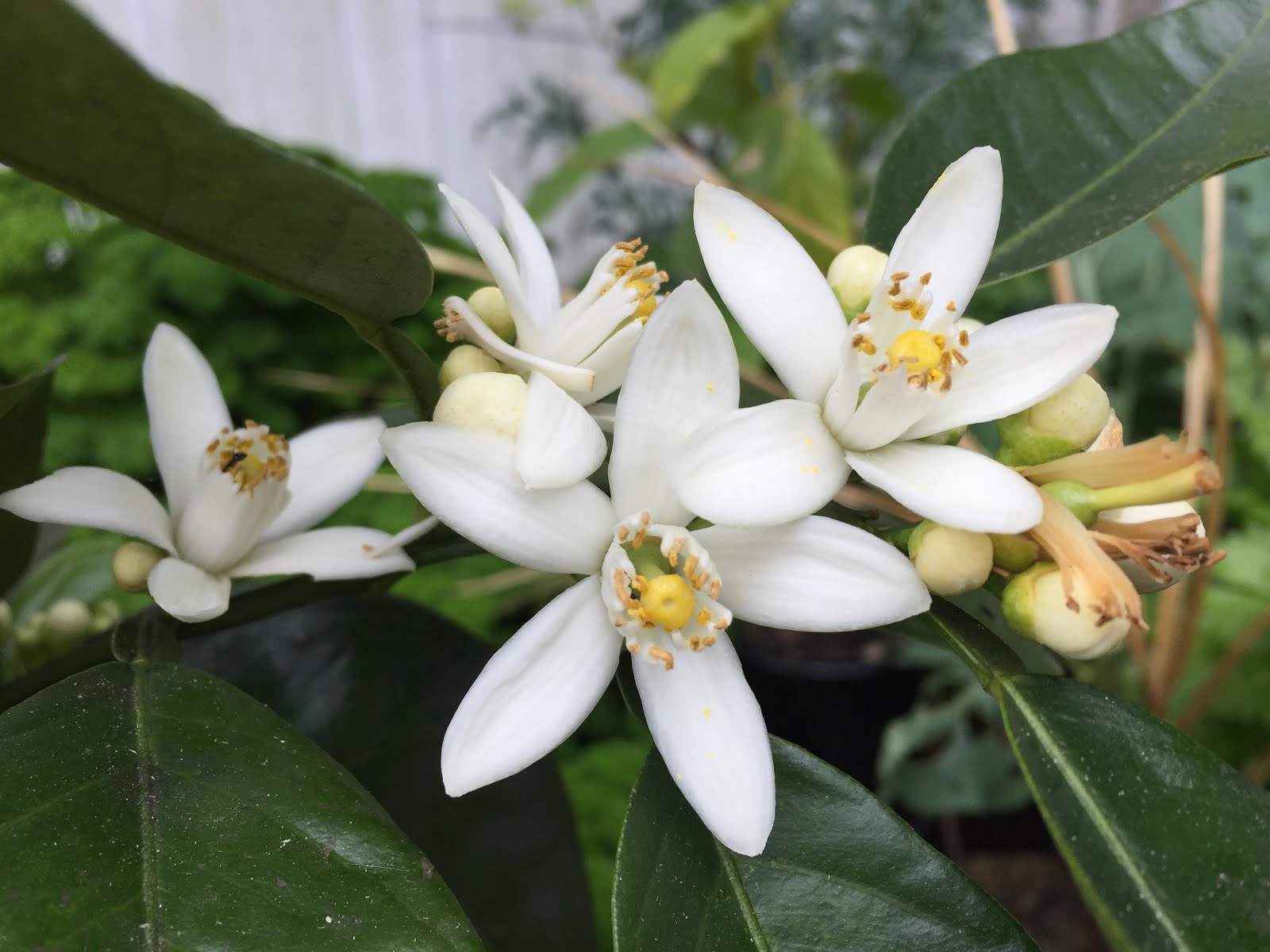
As you can see the Blossoms are large, plentiful and come with the most intoxicating Orange Blossom aroma which wafts throughout the garden, an added bonus to the fruit.
The Seville orange, is also been used in traditional Chinese medicine to treat nausea, indigestion and constipation. The crushed fruit and macerated leaves will lather when mixed with water and is used as a soap substitute in the Pacific Islands. The Seville orange peel, when dried and concentrated, contains a chemical similar to ephedra and has been used in many modern weight-loss products. 

Sour oranges are native to China. Trade routes brought them to Africa and the Mediterranean. This variety was brought directly to Spain by Arab conquerors in the 10th century from northern Africa via Morocco. Cultivation of sour orange varieties led to the Seville orange of Seville, Spain in the 12th Century, where it would accrue its name. The Seville orange was the only orange variety in Europe for the next 500 years. It was also one of the first citrus varieties brought to the New World where it was naturalized in the Caribbean, South, Central and North America. When sweet oranges were introduced to America, sour orange trees would begin to shift their role as edible fruit to rootstock. Cross pollination of the sour and sweet orange trees also proved to create bitter fruits in sweet orange varieties which forced farmers to reduce production of sour orange trees.


A Lemonade is a natural crossbread between an Orange and a Meyer Lemon, first cultivated in the 1980’s in Northland, New Zealand. It grows to about about 2.5-3 metres high. The fruit has the appearance and shape of a lemon though it is easily peeled, and easily segmented. It is unusually sweet and juicy and has a sweet effervescent flavour with a low acid content, tasting of lemonade. It is devoid of bitterness and can easily be eaten as a fresh fruit, or squeezed for drinks. The Lemonade tree often has small thorns and can bear a heavy crop each year. Fruit is ripe when light green in colour and is consumed fresh, juiced, with mixed drinks, or used to make marmalades with other citrus. It is quite popular as a backyard tree throughout NZ & Australia, with a only a few small commercial plantings.


Sunday, 7 August 2016

Blood Oranges


One of the things i look for when deciding on a fruit tree is that it has to be a little bit special than something you can easily find at the supermarket. Because why go to all that trouble to grow something that when its in season will probably be quite cheap & readily available. This is why i love Blood Orange trees. For starters they are very rarely available to buy in stores and when they are, they are imported and always seem a bit past their prime. Yes they are Oranges, but slice them open and you’re rewarded with a surprise – deep, almost purple flesh and a distinct sweet Raspberry flavour. The fruit is usually slightly smaller than most Oranges. 


The distinctive dark flesh color is due to the presence of anthocyanins, a family of antioxidant pigments uncommon in most Citrus fruits. The flesh develops its characteristic maroon colour when the fruit develops with low temperatures during the night.  Sometimes there is dark colouring on the exterior of the rind as well, depending on the variety of blood orange.


The three most common types of blood oranges are the Tarocco (native to Italy), the Sanguinelli (native to Spain), and the Moro (native to Sicily). The Moro is the most pigmented with an almost black colouration and also has the strongest aroma & richest flavour. While also pigmented, Cara Cara navels have red pigmentation too but this is based on Lycopene,  not anthocyanins like Blood Oranges. I have planted at home : 3 Moro, 1 Tarocco, 1 Sanguinelli and 2 Cara Cara. Of these i have only had the Tarocco fruit and it was moderately coloured but took until late in the season (August) to colour up. It seems the Blood Oranges trees take longer to fruit than some other varieties for instance my oldest Moro is just fruiting this year after 4 years!


So why we don’t see Blood Oranges commercially grown in NZ? I think this is partly due to the degree of difficulty in growing them.  To deliver a true blood orange, we need to have the right environmental conditions to help build the levels of anthocyanins.  Half the battle is growing them in the right temperament, in a lattitude that provides harsh, dry and hot summers as well as cool, nippy winters.  The next issue is to then choose a suitable location that will provide maximum temperature differential during autumn & winter.  What this basically mean’s is that to grow Blood Oranges successfully and to their fullest potential, they need to be grown in a location that will provide almost freezing night temperatures as well as high day temperatures.  In a technical standpoint, the stress the tree endures during this weather process forces the tree to develop the much needed anthocyanins.  Not many places that are suitable for Citrus meet this quality. That said, in my garden in Ponsonby, NZ, i was still able to produce Blood Oranges with a good degree of pigmentation last year with my Tarocco. So i look forward to what i can produce when the Moros gets around to fruiting. My theory is they need almost a freeze in winter (i.e.: around 0 degrees Celsius for a few nights at least) to colour up as i checked the Bloods in about June and they were sweet & ripe with no colour. But left until August after a few cold weeks they had good colouration.


Monday, 1 August 2016

Bergamot Orange

Photo: Leslie Seaton
I was going through my Citrus Inventory the other day as i had a rare spot open up in the garden for two new trees. I have quite a good coverage of most Citrus varieties and thought it would be a good idea to choose something extra unusual that i didn't have already. So my shortlist was Sumo/Dekopon (something i've wanted for a while now), Meiwa Kumquat, (another) Yuzu, Afourer Tangor, Lemonade, Ponderosa Lemon, Limequat, Serville Orange and Bergamot Orange. I decided after visiting the store to go with Bergamot Orange and another Yuzu. I chose these mainly because Meiwa Kumquats were out of stock. I have more than enough Lemons with my Meyer & Eureka. Sumo/Dekopon is not avalible in NZ yet:( Limequats seem pointless to me, plus i have 6 Lime trees already. I would have got a Afourer but they were also out stock. 
I am excited by my new Bergamot as its extremely rare to see the fruit in NZ shops. So what do you do with a Bergamot Orange you ask? Lets have a look......

My New Friend.
Bergamot has a long history of commercial culture, grown primarily for the distinctive essential oil from its rind. The area for this is mostly confined to a province of Calabria in southern Italy. Bergamots are defined as green gold, the most valuable citrus in the world.
Bergamot oil is an important component of a Toilet Water (Eau de Toilette), which was first developed around 1675 in Cologne, Germany, by an Italian immigrant. Bergamot oil soon became a constituent of high quality perfumes and of men's perfumes, aka "Cologne".
The other main use of Bergamot Oil is to flavour Earl Grey tea which has been made since the 1820s.

Bergamot is about to experience a Yuzu-style renaissance within the Culinary world with many high-end chefs exploring the distinctly nuanced flavour. It can be used in a wide variety of ways such as:
  • Using the aromatic rind and acidic (yet sweeter and more delicate and floral than lemon) juice to flavour yoghurt mixed with cucumber, fresh dill.
  • It is an excellent partner to fish especially in curing.
  • Add bergamot to Asian-style marinades with soy, ginger and rice wine vinegar.
  • Bergamot juice can also be substituted for vinegar in vinaigrettes for a perfumed tartness.
  • Add bergamot zest to Meringues.
  • Bergamot and Mint make for a refreshing sorbet.
  • Use in Cakes or Icing.
  • Make Bergamot Syrup to add to Prosecco or Sparkling Water.
  • Bergamot-cello (Liquore al Bergamotto)
  • Cocktails
  • Marmalades
Bergamot Sorbet
The refreshing, fragrant flavour of bergamot makes the perfect palette cleanser so try this sorbet at the end of a rich meal.

Ingredients:
4 Bergamots, juiced and zested
150g caster sugar
2 egg whites
300ml water

1. Dissolve the sugar in the water over a low heat, before gently bringing to the boil for a couple of minutes. Remove from the heat and add the bergamot zest, cover and leave to infuse for half an hour.
2. Add the bergamot juice to the sugar syrup, then strain and place in a shallow container. Freeze for two hours until slushy.
3. Whisk the egg whites until fluffy and mix into the sorbet. The sorbet must be only semi-frozen to be able to do this. Freeze for at least 6 hours. Remove from the freezer 10 minutes before serving.

Bergamot Marmalade

Ingredients:
  • 8 bergamots
  • 3 cups Sugar
  • 4 cups (1litre) Water
  • pinch of Salt

  • 1. Rinse and dry the bergamots, then cut each in half and pluck out the seeds.
    2. Cut the bergamots into quarters and using a sharp knife, slice the quarters as thinly as possible.
    3. Add the bergamots to a pot, add the sugar, 1 litre of water, and salt, and bring to a boil. Cook the bergamots, stirring occasionally, until the marmalade begins to set using the wrinkle test: turn the marmalade off and put a dab on a plate that’s been in the freezer then check it after five minutes; if it wrinkles when you nudge it, it’s done. If not, continue to cook, repeating this step, until it reaches the desired consistency (about 30 mins).
    4. Ladle into clean jars and twist on the lids. Once cool, store in the refrigerator, where they’ll keep for at least six months.
Photo: Leslie Seaton


Tuesday, 26 July 2016

Taste Test: Dweet Tangor.


Well today i decided that it was time to crack open & try one of my Dweet Tangors. They all seemed to have fully coloured up and look about the perfect ripeness to eat. So here we go.......

It was quite a large fruit, bigger than your usual supermarket Navel with a rigid, thick, pebbled rind that was surprisingly very easy to detach like a Mandarin.
Once peeled it had very little albedo left on the segments which were easy to separate for a very easy eating of the fruit.
Taste-wise it was very enjoyable. Very sweet but with just a slight tang at the end. 
Taste was mix of a rich Tangerine/Mandarin with Orange finish very flavourful.
Flesh was orange coloured & very juicy but quite delicate like a Mandarin not dry at all.
There were about 5 seeds present but for its size didn't seem to problematic.
Overall it was a very pleasant fruit to eat, way better flavour than an Orange almost like eating a giant Satsuma. 
Im excited about the up-coming Blood Oranges that are next to harvest. Still about two weeks i reckon so i can try and get some good blood colour going!


Sunday, 19 June 2016

Currently In Season: June

With all this cold weather lately we can now say its officially winter. The cold temperatures have also started to colour up all the citrus especially the Oranges which are all starting to be ready to harvest. As they become ripe i will give a review below of the taste & look of each that i try.

Cipo
Cipo Oranges are a unique weeping selection of orange with sweet and juicy fruit with a slight pineapple tang that are ready from late June. Ideal for pots to show off its weeping form. 
I tried one on the 9th June still quite tart and would say they need a few more weeks to sweeten up. Really just regular Orange flavour so far none of the promised Pineapple flavour notes that i could tell. I will try another soon & report back. Fruit size was on the small side but it is its first fruiting season. 
June 29th: Good amount of sweetness now. Fairly normal Orange flavour as you would taste in supermarket Oranges. Will wait another few weeks to see if the flavour develops more.


Cara Cara
Cara Cara oranges are a early to mid-season navel orange. Initially they were a cross between two navels and a mutation then occurred on one branch of Washington navel orange tree, it was discovered in 1976 at Hacienda Cara Cara in Venezuela.  Now, they're largely grown in California.
Cara Caras have the same round shape and bright orange rind as traditional navels. What really sets these oranges apart is what's on the inside. Cara Cara oranges have distinct pinkish-red and orange flesh this is due to Lycopene. It's not just their beautiful color that makes them stand out, they have a remarkable taste that goes right along with it. Compared to traditional navels, Cara Caras are sweeter, slightly tangy, and less acidic, with a hint of red fruit, like cranberry or blackberry. They are also seedless.
I tried the one below on 13th June it has the signature dark orange, slightly pink look to the flesh that you'd expect from a Cara Cara. Taste was still a little tart & puckery these guys will also need to wait a few weeks to sweeten up.
Update: June 28th: Good amount of sweetness now & interesting berry flavours have developed.


The next picture is about a lesson i learnt in relation to young citrus trees. We've all heard the nerdy nurseryman telling us to take off all the young fruit in the first year or two. I would scoff at such talk thinking i want to try that fruit as soon as possible! This year my young Cara Cara worked really hard to produce about 6 Oranges for me. Unfortunately the fork in the central leader couldn't bear the weight of them all even though it was staked for support it split the tree in half. A sad day indeed. Now i will have to prune off that whole side & wait for new growth to balance out that side. Luckily i have another larger Cara Cara as a back up for next year. Lesson to be had was let your tree grow to a point that it is strong enough to carry the weight of its fruit. If not you must thin the fruit to a sustainable amount or support the limbs with adequate stakes. I also figure that in its first few years that it would be a better idea for the tree to focus its energy on building its root system and structure than to produce fruit.


Mandarin: Scarlett Burgess
I tried one today as the fruit are almost completely coloured a bright deep orange with only a few tinted green. The fruit i tried was beautifully sweet with good rich mandarin flavour. Only negative would be the seeds: about 3 per fruit. I ate a supermarket Mandarin to compare afterward and it was pale in comparison for its watery flavour and wasn't as crisp & fresh no surprise.


Blood Oranges: Moro & Sanguinelli
As at 19th June still yellow in colour looks like maybe late July will be ready.


Tangors
As at 19th June still light green